Pre-event Linkedin Marketing
Paid LinkedIn ads can push your event into feeds, but they disappear the moment the budget runs out. The organizations generating millions of organic impressions before their events aren't spending more, they're distributing smarter. According to a 2025 report from LinkedIn's own marketing blog, a consistent cadence of 2 to 5 targeted posts per week in the month leading up to an event drives sustained visibility without touching the ad budget. The strategies below are what event teams actually use to make that happen.
Why the LinkedIn algorithm rewards pre-event content
Before getting into tactics, one number matters: personal profiles generate 561% more reach than company pages posting identical content, according to a January 2026 analysis by Ordinal Social. LinkedIn's algorithm distributes content through social graphs, meaning posts from real people travel further, get commented on more, and stay visible longer than anything a brand page publishes.
For event organizers, this is good news. You don't need a massive ad budget. You need real people, attendees, speakers, sponsors, employees, posting on your behalf. That's the foundation every tactic below builds on.
1. Activate your speakers at least 4 weeks out
Speakers are your highest-authority advocates. When a recognized expert announces they're presenting at your event, their network pays attention in a way it simply won't for a generic company post.
Don't wait for speakers to promote organically. Send them a social toolkit 4 to 6 weeks before the event date. A good toolkit includes a branded visual (with their headshot and session title), a pre-written caption they can edit, the event hashtag, and the registration link. The easier you make it, the more posts actually get published.
2. Turn attendees into promoters before they arrive
This is where most organizers leave the biggest organic impressions on the table. Confirmed attendees already have social proof embedded in their decision, they're proud to be going. All you need to do is make sharing effortless.
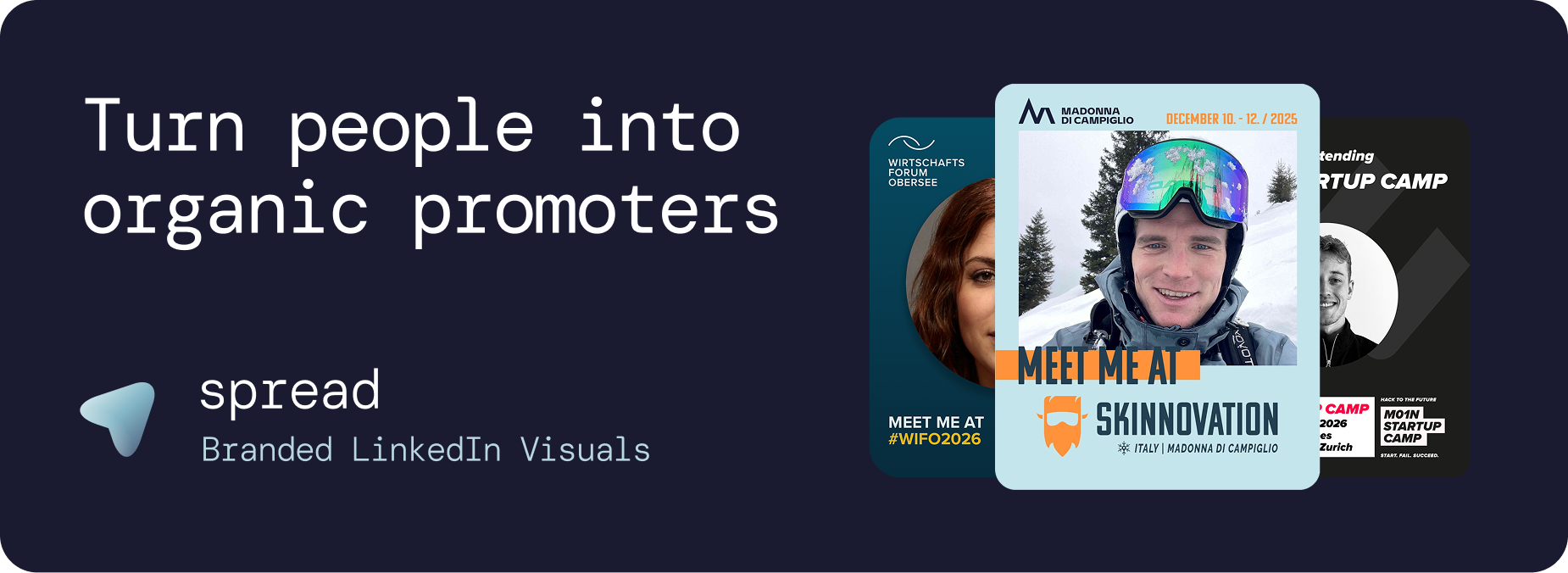
Branded "Meet Me At" graphics work because they combine a personal face with event branding. Each attendee generates a customized visual with their own photo and posts it to their LinkedIn connections. According to Go Spread's benchmark data (drawn from real campaigns across their platform), a single attendee share reaches roughly 2,500 people organically. At 100 attendee posts, that's 250,000+ organic LinkedIn impressions. Organizations using Go Spread for event marketing have documented campaigns reaching well into the millions of impressions from attendee sharing alone, without spending anything on ads.
The key is friction removal. A two-click flow where attendees upload a photo and get a LinkedIn-ready post takes less than 90 seconds. Anything slower sees sharp drop-off in participation.
3. Build a LinkedIn event page and use it actively
Create a dedicated LinkedIn Events page at least 3 to 4 weeks before your event. It gives you a shareable registration link, lets you post updates that notify attendees directly, and sends automated reminders at 7 days and 3 days out. Even if most of your promotion happens elsewhere, having the page live gives the algorithm a hub to anchor your content around.
Post to the event page at least twice a week. Mix formats: a speaker highlight one week, a behind-the-scenes logistics post another, a poll asking attendees what session they're most excited about. Polls in particular get disproportionate engagement because they require a single click to participate, LinkedIn's algorithm rewards that interaction burst.
4. Give sponsors a reason to post (and make it easy)
Sponsors have audiences you don't. Their followers are often precisely the professional demographic your event is targeting. Yet most organizers treat sponsors as passive logos on a banner rather than active distribution channels.
Send sponsors a co-branded visual kit the moment they confirm. Include graphics sized for both LinkedIn post format and LinkedIn story format. Pre-write two or three caption options at different lengths. If a sponsor's team has to write a caption from scratch, you'll lose most of them. If they can post in 30 seconds, participation rates jump considerably.
For organizations managing multiple sponsor relationships, Go Spread's sponsor activation tools make it possible to generate sponsor-specific branded visuals at scale, without a design team.
5. Run a content countdown, not a single announcement
One announcement post three weeks before the event does almost nothing. A planned series of posts spaced 3 to 5 days apart does a great deal.
Structure your countdown around reveals. Drop one speaker announcement per week. Reveal the venue or agenda highlights. Post a "10 days to go" graphic. Each post gives the algorithm fresh content to distribute, keeps the event in followers' feeds over a longer period, and gives your team a reason to tag speakers and sponsors (which extends reach further into their networks).
According to LinkedIn's May 2025 event promotion guide, the ideal promotional runway starts 4 to 6 weeks before the event. Starting earlier than that tends to generate low engagement because the event feels abstract; starting later compresses your reach.
6. Post native content, not just links
LinkedIn's algorithm penalizes posts that send people away from the platform. A post that says "Register here →" with a bare link consistently underperforms a post that shares a speaker quote as an image, tells a brief story, or presents an agenda highlight as a document carousel.
Save the registration link for the comment section, or include it at the end of a post that leads with strong native content. Native video performs especially well: according to benchmarks compiled by Informa TechTarget, LinkedIn live video generates engagement rates up to 24 times higher than standard text posts. Even a short 60-second speaker teaser filmed on a phone outperforms a polished graphic with a link.
7. Engage with comments and tags systematically
Posting is only half the job. Posts that receive early comments in the first hour of publication get distributed more broadly by the algorithm, which prioritizes content with active engagement signals. That means someone on your team should be prepared to comment on every post within 30 to 60 minutes of it going live.
Tag attendees when they share your content. Reply to every comment on your event posts, even briefly. When speakers and sponsors post their advocacy graphics, comment from your company page and from personal profiles on the team. According to a 2025 analysis cited by LinkedIn creator Chris Donnelly, posts with active comment threads see up to 29% higher reach than posts with the same number of likes but no comments.
The compounding effect of organic advocacy
Each of these strategies works individually. Combined, they produce something the algorithm rewards at scale: distributed, person-to-person content that looks like genuine professional conversation, because it is.
The math is straightforward. If 150 attendees share a personalized graphic, 10 speakers post their announcement, and 5 sponsors activate their teams, you're looking at potentially 500,000 or more organic LinkedIn impressions before a single euro or dollar of ad spend. Organizations like Startup Nights, Swiss Economic Forum, and Latitude59 have generated that volume consistently using this approach through Go Spread's attendee advocacy platform.
Organic LinkedIn visibility before an event isn't a lucky outcome. It's what happens when you make it structurally easy for the right people to share the right content at the right time.