



How to get more people attending my conference?
Every conference organizer eventually hits the same wall. Registrations plateau, the paid ad channel gets more expensive quarter after quarter, and the email list you spent years building starts to feel tired. You need more people attending your conference, and you need the growth to come from somewhere other than a bigger media budget.
This guide is the playbook we use ourselves and share with the organizers who run campaigns on Go Spread. It focuses on the mechanics that actually shift registration curves in 2026: turning your existing audience into a distribution engine, tightening your funnel, and treating event marketing as a compounding system rather than a launch push.
Start by fixing the funnel for event marketing
Before adding traffic, look at the drop-off between "landed on the site" and "clicked register." Most conference pages leak here badly. Common culprits: an unclear one-line value promise, a hero image that doesn't show the room or the speakers, five different CTAs competing above the fold, and a registration form that opens on a different domain.
Fix these first. Doubling top-of-funnel traffic against a leaking page is expensive. A cleaner page with the same traffic often adds 20-40% more registrations without spending a cent more on acquisition.
One sentence that says what the event is, who it's for, and what the attendee walks away with
Speaker faces above the fold, not a stock crowd shot
A single primary CTA repeated at logical intervals down the page
Social proof: named companies attending, testimonial quotes with photos, previous-year numbers if you have them
A visible FAQ answering price, refunds, dates, format, and travel
Turn every speaker into a distribution channel
Your speakers already have the audience you want. A mid-level speaker with 8,000 LinkedIn followers who posts about their upcoming talk will out-perform any brand-page post you can run. The problem is that most speakers never post, or they post something generic three days before the event.
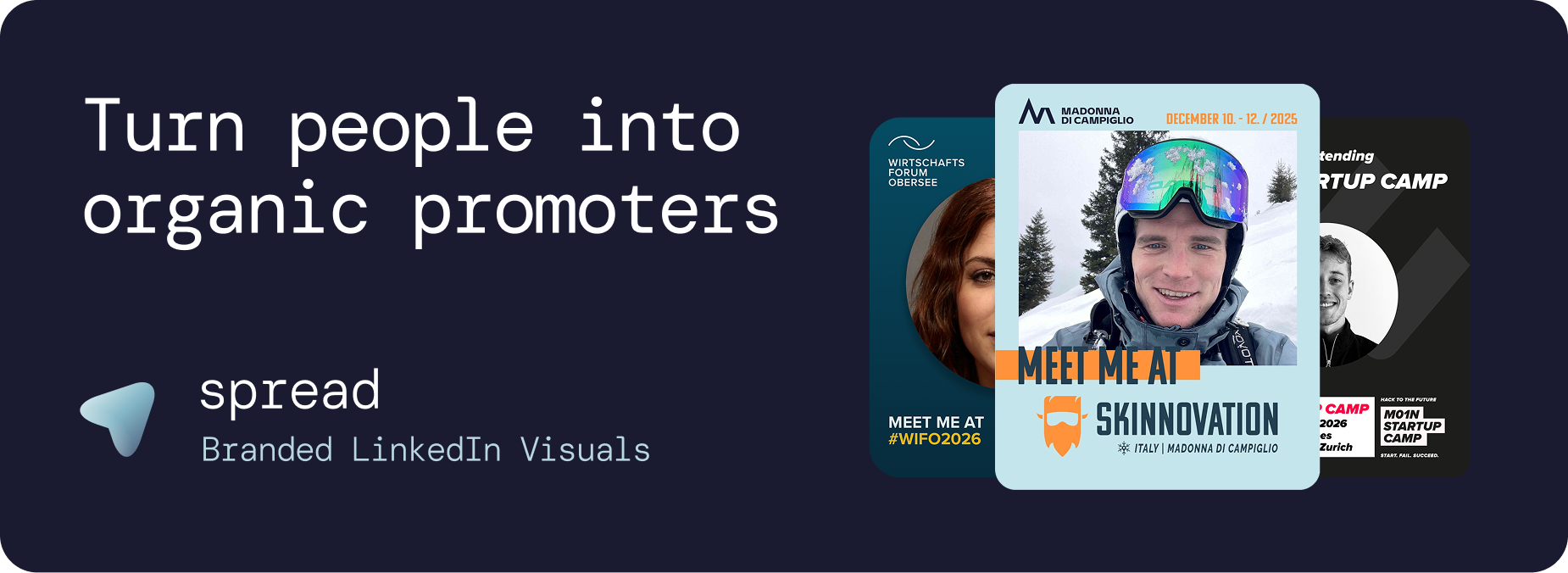
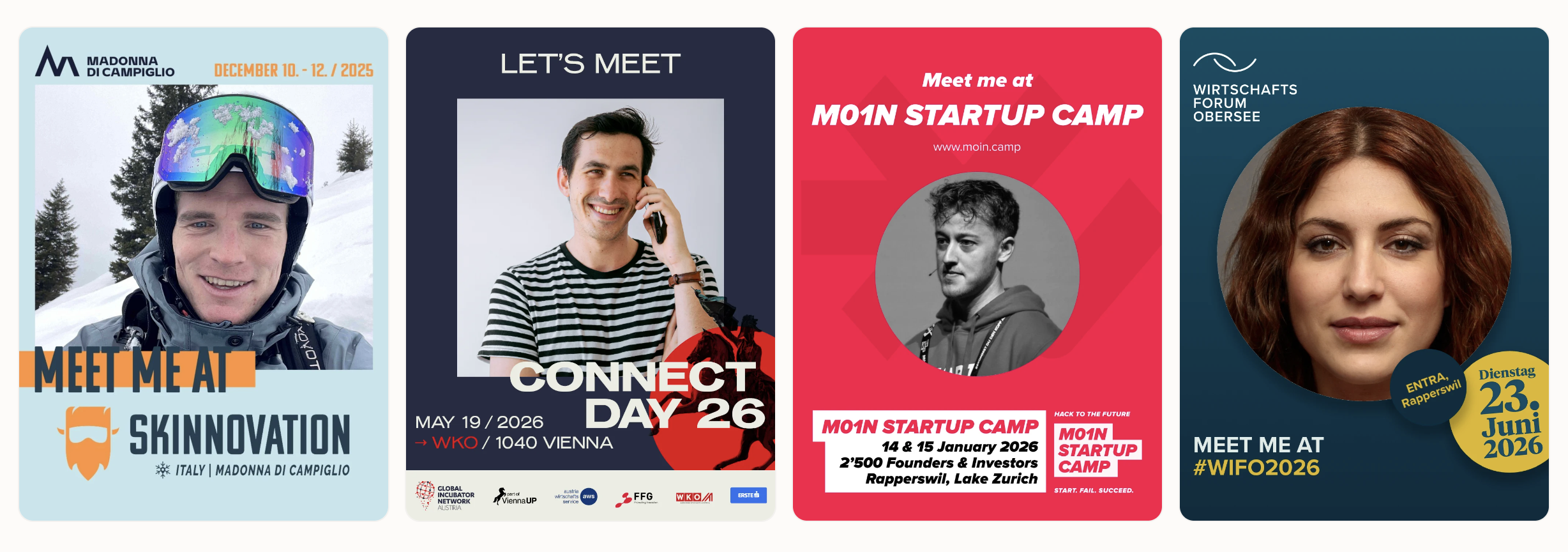
Make it effortless. Send each speaker a personalized branded graphic the moment they confirm, with their photo, their session title, and the event branding. Pair it with a caption they can copy or edit. This single change routinely lifts speaker posts from 20% participation to 70-90%.
Benchmark: Across the events we track on Go Spread, a single speaker share on LinkedIn generates around 2,500 organic impressions on average. Twenty active speakers moves the needle more than a $10,000 ad spend.
Speaker advocacy and an article about attendee advocacy platforms.
Turn every attendee into a promoter too
Speaker advocacy is the ceiling. Attendee advocacy is the volume. Once someone registers, they are already invested. They want to be seen at the event. The reason more of them don't post is not reluctance, it's friction and uncertainty about what to say.
Here is a detailed article on how to get attendees sharing about your event (attendee advocacy)
The pattern that works: on the confirmation page and in the confirmation email, hand them a personalized "I'll be there" graphic they can generate in under a minute. No login, no download of design tools, no thinking about captions. One link, upload a photo, done.
Across 100 attendees doing this, we consistently see 250,000+ organic impressions and a compounding effect as their networks see the same event mentioned by multiple credible people they already know. That is the exact mechanism LinkedIn's algorithm rewards, and no paid campaign can replicate the trust of a peer's face on a personal post.
Design a 90-day pre-event content wave
One announcement doesn't move registrations. A steady drumbeat does. Map the 90 days before your conference into three waves, each with a different job.
Days 90 to 60 (Awareness): speaker announcements, agenda themes, "why this year is different." Goal: get the event on the calendar.
Days 60 to 21 (Consideration): deep-dive posts, session previews, community quotes, early-bird urgency. Goal: convert the warm audience.
Days 21 to 0 (Urgency and social proof): attendee cards flooding LinkedIn, "last seats" scarcity, logistics detail, FOMO content. Goal: capture the fence-sitters.
Each wave needs owned content from your team, plus a fresh batch of assets your speakers, sponsors, and attendees can share. If you plan the assets in a single sprint at the start, execution across 90 days becomes routine.
Recruit sponsors and partners as marketing muscle
Sponsors want reach. Partners want visibility. Both will happily post about your conference if you make it easy and if the graphic makes them look good. Co-branded partner cards, with the sponsor logo alongside your event branding, unlock networks your team could never reach directly.
Tip: Include shareable partner assets in the sponsor contract. It costs the sponsor nothing, and their post to a network of 5,000 to 50,000 professionals is worth more than most mid-tier sponsorship benefits combined.
Own your community year-round and get more people attending your conference
Conferences that grow fastest treat the event as one moment inside a year-round community, not a one-off product launch. A Slack group, a monthly newsletter, a small in-person meetup between editions, all keep the audience engaged and make the next registration cycle feel like a natural next step rather than a cold ask.
Community-fed conferences typically see 30-50% of tickets sold to returning attendees, and returning attendees are also the group most likely to post, refer, and pull in first-time colleagues. Community is the flywheel that quietly compounds year over year.
Use email like a professional, not a spammer
Email still converts registrations better than any other single channel, but the days of blast-sending your entire list eight times work against you. Segment aggressively. Past attendees get a different sequence than cold subscribers. People who clicked the agenda page get a different sequence than people who bounced from the pricing page.
One warm, personal announcement from the founder, plain-text style
Speaker-focused emails timed to each new confirmation
A "why now" mid-cycle email that anchors urgency to real deadlines
A final 48-hour email with a single link and a single sentence
Volume matters less than relevance. A tight five-email sequence to a segmented list will out-perform twelve emails to everyone.
Track the right things
Most conference teams measure the wrong stuff. Impressions and follower counts are vanity. What matters is a small set of numbers you can actually influence week over week.
Registrations per week, split by acquisition source
Landing page conversion rate
Speaker and attendee share rate on LinkedIn
Estimated organic reach from personal shares
Cost per registration, blended across paid and organic
If the share rate drops, your creative is stale. If landing page conversion drops, something on the page broke or shifted. If cost per registration climbs, your paid mix is out of balance. These five numbers give you a weekly steering wheel instead of a post-event autopsy.
Where Go Spread fits in to get more people attending your conferences and events
Go Spread is the tool we built for the personalized-graphic piece of this playbook. Organizers upload a branded template, define where the participant's photo and name go, and share one link. Attendees, speakers, and sponsors generate their own version in under 60 seconds, no login required, and share it straight to LinkedIn. Everything runs on your branding, and photos are processed entirely in the browser so nothing hits a server. Pricing scales with participation, never per download.
If you want to see how the mechanics work for your own conference, the free tier is enough to run a full pilot with your speakers before you commit to anything.
Getting more people to attend your conference is not a traffic problem. It's a distribution problem, a funnel problem, and a community problem, in that order. Fix the page, activate the people already inside your orbit, run a 90-day content wave, and measure five numbers instead of fifty. Do that and registrations climb without a bigger ad budget, which is exactly the outcome every organizer is actually chasing.