



How to boost organic LinkedIn impressions for your conference
Organic reach on LinkedIn company pages has dropped 60–66% since 2024, according to Brenton Way's 2026 LinkedIn Marketing Statistics report. Yet corporate conference organizers who understand how the platform actually works are still generating hundreds of thousands of impressions per event without spending a dollar on ads.
The gap between those who struggle and those who succeed comes down to one thing: whose voice carries the content. Company page posts are increasingly deprioritized. Posts from real people are not.
Here's what actually moves the needle.
Your company page can't win this fight alone
LinkedIn's algorithm is built to reward "meaningful social interactions," and a post from a human profile consistently triggers more of them. According to a January 2026 LinkedIn pulse piece by Serge Bulaev, employee posts outperform company pages by 6 to 8 times in organic reach. That's not a small edge, it is the difference between 300 impressions and 2,400 on the same content.
For a corporate conference, your real amplification assets are your speakers, executives, sponsors, and attendees. The organizer's page is useful for credibility, but it should not carry the main load.
Activate speakers and executives before the event
Speakers are your highest-leverage advocates. Each one has a professional network that almost certainly overlaps with your target audience. Brief them 3–4 weeks out with a short content guide: one post announcing their participation, one teaser about their session topic, and a prompt to share the event link.
Keep the ask minimal. Pre-write a draft caption they can personalize, posts with small personal edits get significantly more reach than copy-pasted text, as MarketingProfs noted in their 2025 analysis of 500,000 LinkedIn advocacy posts. Tag the conference page in those posts and you will capture secondary reach as attendees engage.
Turn attendee pride into a distribution channel
Attendees at a corporate conference are often proud to be there. They want their networks to know. The challenge is that the path from "I will post about this" to an actual published post is longer than most people realize.
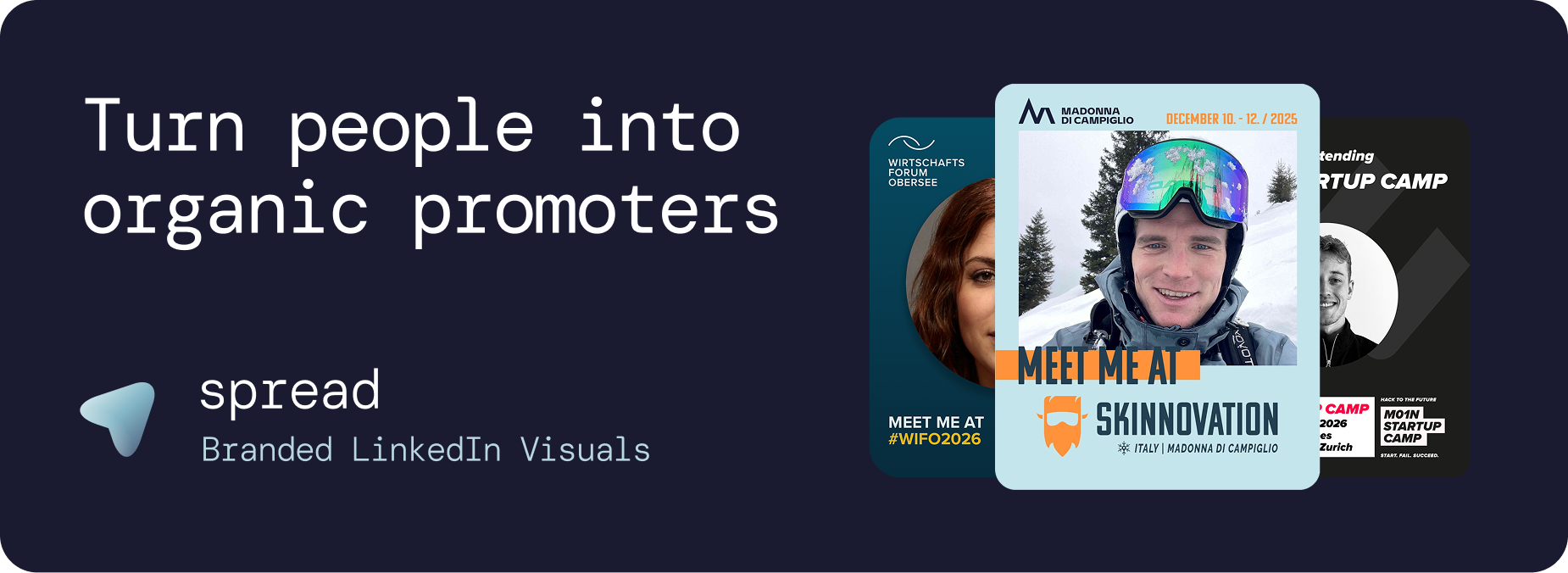
This is where purpose-built tooling removes the friction. Go Spread is designed exactly for this scenario: organizers create branded "Meet Me At" visuals, attendees personalize them with their own photo in a two-click flow with no login required, and post directly to LinkedIn. The platform generates LinkedIn post and story formats, pre-writes the caption, and handles one-click sharing.
The math here is compelling. Go Spread's benchmark data from their event partners shows roughly 2,500 organic impressions per attendee post. At 100 shares, that is 250,000 organic impressions from a single campaign, the kind of scale typically associated with a mid-sized paid ad buy, delivered for a fraction of the cost. Their platform has driven over 7 million organic impressions across events to date.
You can see how these campaigns scale for conferences at go-spread.com/events.
Use personal profiles strategically, not company posts
If you want your content seen, it needs to come from people. Your CEO's post about the conference will reach more relevant professionals than the company page post saying the same thing. The same logic applies to your marketing team, your sales team, and your operations staff.
This does not require a formal employee advocacy program. For a single conference campaign, a shared Slack message with two or three draft post options is enough. Ask team members to pick one, add a line about why they are personally excited, and post it the week before the event and again on the day.
According to a 2026 DSMN8 benchmark report, 94% of employee advocates say posting on LinkedIn has directly benefited their own careers, so this is not a hard ask. Most people are happy to participate when the process is genuinely easy.
Post timing and format matter more than most organizers think
LinkedIn's algorithm evaluates a post's performance in the first 90 minutes after publishing, according to Postiv AI's 2026 algorithm guide. Replies to comments within that window can boost reach by up to 35%.
For conference content, this means coordinating post timing across your speakers and team so engagement lands within a concentrated window. Mid-week posts (Tuesday through Thursday) outperform Monday posts, when feeds are noisier and dwell time is lower.
On format: native document posts, often called carousel posts, generate about 6.60% average engagement, the highest of any LinkedIn format per Supergrow's 2026 analysis. A short deck of 5–7 slides with key session themes or speaker quotes is an easy asset to build and gives attendees a reason to interact rather than just scroll past.
Build your LinkedIn Event page and use it actively
A LinkedIn Event page serves a practical function: when someone marks "Attend," LinkedIn automatically sends them reminders at 7 days, 3 days, and event start time. That is a notification stream you do not have to pay for.
Encourage every speaker, sponsor, and team member to click "Attend" on the event page. Each of those actions creates a notification in their network's feed, generating passive impressions before a single promotional post goes live.
Share the event page from personal profiles, not just the company page. A speaker sharing the event page to their 8,000 followers reaches a far more targeted audience than your brand page reaching its followers.
Measure what you are generating, and report it clearly
Organic campaigns often go under-reported because the data is scattered across individual profiles. Build a simple tracking sheet: ask advocates to share post URLs, pull impression and engagement data manually or through a tool, and sum it weekly.
For teams using Go Spread, real-time analytics show views, downloads, shares, and LinkedIn impressions in one dashboard, making it easy to report ROI to sponsors or leadership without chasing data across profiles.
The bottom line is that organic LinkedIn reach for corporate conferences is still very much achievable. Company pages just cannot carry it alone. When your speakers, executives, and attendees each post once with properly branded, frictionless tools, the cumulative reach of 50 to 100 individual posts will consistently outperform anything your company page produces on its own, and at a cost that makes paid ads look hard to justify.