How to get speakers and attendees sharing your event on LinkedIn
Organizing a startup summit or other business conference is hard enough. Getting the people who actually show up to talk about it on LinkedIn before doors open, that's where most organizers lose momentum.
The good news: you don't need a paid social budget. You need a system that makes sharing easy, looks professional, and gives attendees and speakers a genuine reason to post. Here's how to build that system.
Why LinkedIn is your highest-leverage pre-event channel
Company page posts on LinkedIn now reach roughly 1.6% to 2% of followers organically, according to the Algorithm InSights 2025 Report, which analyzed 1.8 million posts. Personal profiles are a different story. Research published by Refine Labs found that personal profiles generate 5x more engagement than company pages, and attendee or speaker advocacy expands brand reach by approximately 561% compared to brand-only publishing.
For a startup summit, this gap matters. Your attendees collectively have 10x more first-degree connections than your event page has followers. When even 100 of them post about the event, you're not getting incremental reach, you're getting a meaningful shift.
Based on benchmarks from events using attendee advocacy campaigns, roughly 100 LinkedIn posts from attendees generates 250,000+ organic impressions. That's peer-to-peer visibility no ad budget reliably replicates at that cost.
The three groups you need to activate before event day
Not all pre-event sharing is equal. The highest-impact approach treats speakers, sponsors, and attendees as three separate activation waves, each with its own timing and its own asset.
Speakers: your first and highest-leverage wave
Speakers are your most powerful organic channel. They already plan to post about their talk. Left to their own devices, they'll use a generic photo and a plain caption. Give them a branded "I'm Speaking at" graphic, their headshot, their talk title, your event branding, and their post becomes a piece of visual content that stands out in the feed and carries your identity to their entire network. A speaker with 5,000 connections posting a well-designed branded graphic can easily generate 10,000–20,000 impressions from a single post.
Send the personalization link the moment their session is confirmed. Then follow up three weeks before the event. Most speakers will post both times.
Attendees: where the hype peaks
Attendee hype doesn't build on event day, it builds the week before. That's when people start telling their network where they'll be. Make it effortless by sending a personalized "I'm Attending" or "Meet Me At" graphic link at four specific moments: inside the ticket confirmation email, four weeks out, two weeks out, and one week before the event. The final touch consistently drives the biggest wave of shares.
The key insight here is friction. If attendees have to log in, install an app, or spend more than 30 seconds creating their graphic, most won't. The tools that work best let someone upload a photo, generate a branded graphic, and share it to LinkedIn in two clicks, no account required.
Sponsors and partners: earned media that justifies the spend
Sponsors need content to justify their investment internally. A co-branded "We're sponsoring" or "Visit us at booth #X" template gives their marketing team something to post, and your logo travels into their network alongside theirs. Send the link four weeks out, follow up at two weeks. About 40–60% of people who open the link download the graphic, and a large share post the same day.
What makes a branded event graphic actually get shared
The visual design determines whether someone feels proud to post or quietly skips it. A few things that consistently improve share rates:
Photo-forward design. The attendee's or speaker's face should dominate at least 40% of the graphic. People share content they're personally in.
Clear event identity. Event name, date, and location should be immediately readable. A first-time visitor to someone's LinkedIn feed should know exactly what the event is.
Role specificity. Separate templates for speakers, attendees, judges, and mentors outperform generic designs. People post more when the graphic reflects their specific role.
Pre-written captions. Most people know what they want to say but stall at the blank text field. Providing a ready-to-use LinkedIn caption removes that friction entirely.
For startup events in particular, the visual should feel energetic and founder-native, not overly corporate. The Swiss Startup Association, Latitude59, and Startup Nights are examples of ecosystems that have used this format to drive consistent organic reach on LinkedIn before their events.
How to set this up without a design team
The traditional workflow, building individual graphics in Photoshop or exporting from Canva for each attendee, doesn't scale past a handful of VIPs. The approach that works at 50 to 5,000 attendees is a shareable campaign link that generates personalized graphics automatically.
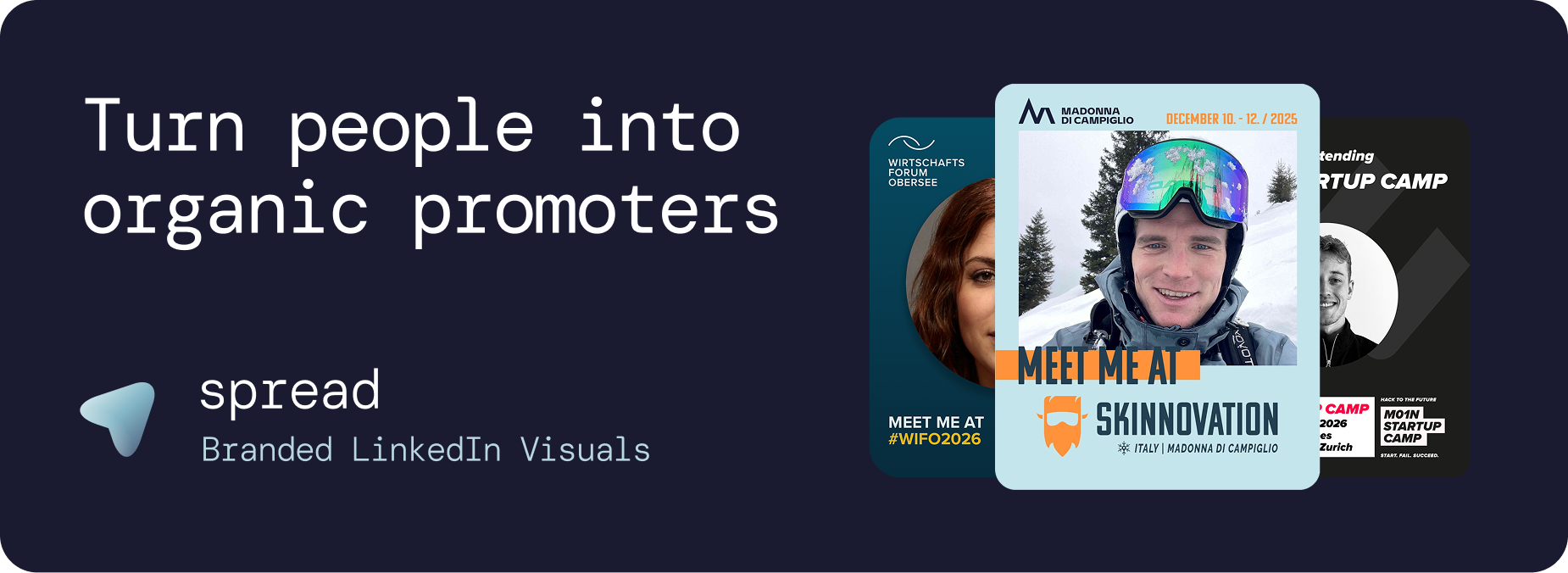
Go Spread is built specifically for this workflow. You upload your event template (or use the builder), define where the attendee's photo goes, and auto-import your brand colors, logos, and fonts from your event website. You get a unique campaign link to distribute through email, newsletters, or your event site. Attendees open the link, upload a photo, and get a branded LinkedIn-ready graphic with a pre-written caption in under 30 seconds, no login, no app, no design knowledge required.
The platform includes real-time analytics tracking views, downloads, shares, and estimated LinkedIn impressions. M01N Startup Camp, Switzerland's third-largest startup conference, used Go Spread to generate 250,000+ LinkedIn impressions in 1.5 weeks with zero ad spend. At the Go Spread events page, the benchmark across partners is approximately 2,500 organic impressions per attendee post.
For reference on the ROI math: 200 attendee posts at that rate equals roughly 500,000 organic impressions. The equivalent reach bought through LinkedIn Ads at a $50 CPM would cost around $25,000.
The pre-event timeline that organizers use
Timing matters as much as the assets themselves. A workable structure:
T-minus 3 to 2 months: Your own team and volunteers post their I'm Attending graphics. This seeds early social proof and targets the exact audience you want at the event.
T-minus 6 to 3 weeks: Roll out speaker graphics. Send each confirmed speaker their personalized link with a short note explaining how it works.
T-minus 4 to 2 weeks: Activate sponsors and partners with co-branded templates.
T-minus 4 weeks through T-1 week: Send the attendee campaign link in four touches, ticket confirmation, four weeks out, two weeks out, one week out.
The week before the event is when LinkedIn activity around startup summits tends to spike. Being ready with assets by then isn't optional, it's the whole game.
Measuring what actually matters
Download counts are a leading indicator. LinkedIn impressions are the outcome that matters when you're talking to sponsors or justifying your marketing spend to leadership.
Track both in real time so you can optimize while the campaign is still running, nudging your speaker list if shares are low, resending to attendees who opened but didn't download. That live feedback loop is what separates campaigns that hit 100,000 impressions from ones that plateau at 20,000.
At the end of the pre-event window, the number of organic LinkedIn impressions your summit generated is a concrete, sponsor-ready proof point. For a startup ecosystem trying to grow year over year, that number compounds, each edition builds brand recognition that makes the next one easier to sell.